Perhaps the most important thing for a church pianist to learn and master is the ability to improvise. When you are learning to play the piano, you are taught to read notes, then phrases, and then entire songs. Everything you need to know is written down on the music in front of you. You simply learn to interpret those little dots and lines into music.
However, when you sit down to play for congregational singing, it’s written in four-part harmony. Soprano, alto, tenor and bass notes are all that you get. It’s perfect if you’re a singer, but if you’re a musician, you’re going to have to get creative.
Why improvise?
A good accompanist is going to push the music forward and keep the tempo going. There’s nothing worse than a triumphant hymn being sung like a funeral dirge! The problem is, when you come to those long three and four beat holds at the end of a phrase, it’s difficult to get the whole crowd moving forward again. And the larger the crowd, the heavier the drag. That’s where improvisation comes in. SOMETHING needs to fill that empty space, and the pianist is in charge of that something.
Not only do you need to push the music forward, but you can help give confidence to the director and the congregation by filling the room with bold, powerful chords. People simply won’t sing out if they feel like they will be heard over the music. Providing a full backdrop for them to add their voices in praise makes it easier for even the most timid to participate in the song service.
The 3 note chord
The very first thing I teach students when they are ready to play out of the hymnal is the concept of a “3 note chord” in the right hand. Instead of only playing the soprano and alto parts, simply add the tenor note in to create a triad in the right hand. Quite often, your RH thumb can simply drop down to play that tenor note. Sometimes it will just be out of reach, so you will need to do a little bit of mental gymnastics and adjust a bit.
If it’s too low to play as written, bump the note up an octave. Usually that means it will end up in the middle of your soprano and alto note. What results is a nice, tight harmony that’s pleasing to the ear. Then, in the left hand, simply double the bass note and play it as an octave. You then are able to give a solid foundation to a richer sounding chord and immediately improve your hymn playing.
The 4 note chord
Most often, this is what I’m playing during the congregational singing, especially when we are learning new music. The 4 note chord is simply playing the 3 note chord and then doubling the soprano note down an octave. Look at the example below:
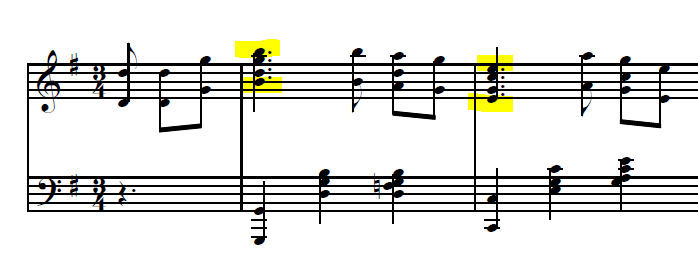
This creates a full sound that will carry over the singing because it’s played in the upper register. It’s perfect for bold, upbeat songs and is easy to learn with a little practice.
Fillers
Once you become comfortable with playing fuller chords and have a good understanding of the basic theory behind them, it’s time to move to filling the “empty spaces” in the music. There are several ways to fill in the music when you are holding something for several beats.
- Instead of a block chord, play a broken chord
- Use the measure to “walk” up or down with the bass to the first note in the next measure
- Play an arpeggio in the right or left hand
- Play a scale (it doesn’t have to be exactly 8 notes, it just needs to fit in the rhythm)
- Repeat the chord up or down an octave
- Play ornamental notes-get creative!
Options for the left hand
Most church pianists find it difficult to know what to play in the left hand when learning to improvise. It’s very easy to get into a habit of doing things a certain way and then never push yourself beyond that. I can’t sit beside you and work through every song in the hymnal with you, but I can give you a few ideas and encourage you to try them all!
Stride Bass
This is probably one of the most commonly used accompaniments for hymn playing. Stride is simply the style of playing low octaves (or other intervals) on the first and third beats of a bar and chords higher on the piano on beats two and four. If you still aren’t sure what I mean, think of the first couple bars of The Entertainer. That classic “ragtime” bass (or a variation of it) is often used in hymn playing.
It’s very important to know basic chords and be comfortable with inversions when playing this way. Being able to invert chords keeps them from all sounding the same. Many hymns are very simple in their structure, and you’re going to be playing a lot of primary chords (the I, IV and V chords in each key signature.) So to break things up, play a first or second inversion of the chord in your left hand, rather than always playing in root position.
Arpeggios
Once again, here’s another important reason why you need to absolutely KNOW your basic music theory when it comes to chords. An arpeggio is simply a broken chord played in rhythm. But oh-so-often the typical church pianist will play these incorrectly! If you are playing a C in the bass, don’t assume that the next note up in the arpeggio should be an E or a G (as in C-E-G for a C major chord.)
Sometimes you may be playing an INVERSION of a different chord entirely. For example, you could be playing a C as your lowest note in the bass, but it’s actually part of an F major chord (F-A-C) so you most definitely do NOT want to play and E or a G next in that arpeggio! Don’t base everything off the first note-be sure to take in the entire chord from bass to treble clef and then decide what to play.
Intervals
Personally, I play a LOT of octaves in my left hand. It was the way I was taught when I started playing for church, and it’s almost a necessity when you are playing in a large room or for a large crowd. It allows for doubling up on the root and getting a solid foundation for the big four note chords in the right hand. However, sometimes less is more.
I’ve been working on adjusting my playing style and making myself be more thoughtful about how I play on Sundays. Now that I have a second piano and an orchestra playing with me, I don’t have to fill the room with as much sound as I used to when I was playing alone. So another option is to play around with different intervals. Instead of an octave, try playing a 7th. Just drop your top thumb down to the next note in the scale. For example, see this excerpt from one of Greg Howlett’s arrangements:
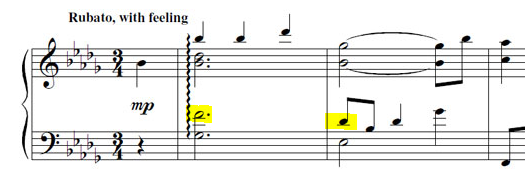
Instead of a G flat octave in the left hand, he drops down to an F. Then the next measure he’s playing a D flat instead of an E flat. Just by dropping down one note, it adds a rich voicing to the harmony and grabs the listener’s ear.
Granted, during congregational singing, this is not likely to be heard and noticed, but it’s a good place to start practicing the concept. This type of harmonization is ideal for invitations! You can also try playing 5ths and 6ths in the left hand accompaniment.
Style matters
The last thing to remind you is that you need to play to the style of the song. “I Surrender All” is not a good time to start practicing the stride bass! “Victory in Jesus” isn’t really a soft, flowy song, so arpeggios aren’t really going to work there. Play around with it and don’t be afraid to just try new things.
The best thing about playing for congregational singing is the freedom to try something different. You have multiple verses of the song to get it right, and there are people singing along and covering up any mistakes you might make. Just keep trying new things!